
WorldatWork recently released the results of a survey investigating the remuneration practices of a broad range of US companies (581), including those with global operations.
The survey canvassed a wide variety of issues, raising some interesting points that may have relevance for the Australian market. Key survey results included:
-
- 85% of the respondents targeted base salary payments at the median, although only 66% actually paid workers at the median.

-
- When determining the relative value of jobs, 89% of respondents referred to market pricing. Only 13% considered job ranking, 18% considered job classification and 18% considered point factor analysis.
- When determining the level of base salary increases:
- 71% of respondents considered individual performance against job standards and 49% considered performance against objectives.
- 59% considered the employee’s position in a range and 49% considered the market value of the position.
- 22% considered skill or competency acquisition and 10% considered education qualifications.
- Only 9% implemented a general increase and 11% implemented increases based on years of service.
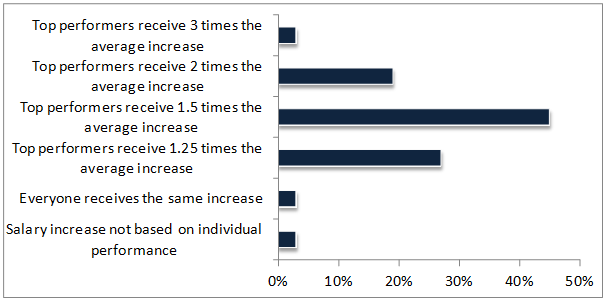
- Where salary increases are based on performance, top performers received 1.5 times the average increase for 45% of respondents.
- When awarding increases to employees:
- 96% of respondents stated that they awarded promotional increases,
- 95% awarded merit-based increases,
- 77% awarded market adjustments,
- 70% awarded internal equity adjustments,
- 40% awarded temporary special assignment pay,
- 45% awarded pay to compensate for hazardous work or specific skills, and
- 33% awarded geographic adjustments.
- Only 11% awarded cost of living adjustments and 3% length of service adjustments.
- 87% of respondents offered variable pay to employees (not including sales commission plans).
- The most frequent measures to rate salary programs were employee turnover/retention and employee satisfaction.
